If you’ve been shopping for a genuine, fully electric family hauler over the past year, you already know the market has been to put it politely a bit sparse. Sure, there are plenty of luxury electric crossovers that claim to seat seven, provided those rear passengers are toddlers or contortionists.
But when it comes to the battle of the 2026 Hyundai Ioniq 9 vs Kia EV9, the industry has finally delivered what American families have been clamoring for: genuine, no-compromise, three-row space powered by electrons instead of gasoline.
At first glance, this looks like a straightforward case of corporate badge engineering. Both vehicles are built by the Hyundai Motor Group. Both ride on the exact same state-of-the-art E-GMP 800-volt platform. Both are arriving in driveways across the country right now, vying for the title of the best 3-row electric SUV on the market.
But spend a week behind the wheel of both, as I recently did, and you’ll realize these corporate cousins are dramatically different beasts. One is a sleek, ultra-efficient highway lounge designed to slice through the air; the other is a blocky, muscular brawler that wants to tow your boat to the lake.
Here is the unvarnished, real-world breakdown of how the 2026 Hyundai Ioniq 9 and the Kia EV9 actually compare when you get them off the spec sheet and onto the asphalt.
The Foundation: The Magic of the E-GMP Platform
Before we pit them against each other, we have to talk about what they share. If you’re dropping north of sixty grand on a family vehicle, you need to know the bones are solid. Both the Ioniq 9 and the EV9 utilize the 800-volt Electric-Global Modular Platform (E-GMP).
Why should you care about voltage? Simple: time. If you’ve ever tried to keep three kids entertained at a highway rest stop while your EV slowly trickles electricity into its battery, you know that charging speed is the ultimate luxury. The 800-volt architecture allows both of these SUVs to pull charge at staggering rates—up to 350 kW on a compatible DC fast charger. That translates to taking the battery from 10% to 80% in about 24 minutes.
Furthermore, both 2026 models now come standard with the NACS (North American Charging Standard) port right from the factory. No clunky adapters are required to use the vast Tesla Supercharger network. This single feature completely changes the calculus for road-tripping an EV, effectively eliminating the charging anxiety that plagued early adopters.
But that shared DNA is where the similarities end. Let’s look at how they diverge.
Design and Presence: Aerodynamic Sleekness vs. Unapologetic Brawn
You don’t need an advanced degree in automotive design to see the philosophical split between these two automakers. Walk up to the vehicles in a parking lot, and the contrast is genuinely startling.
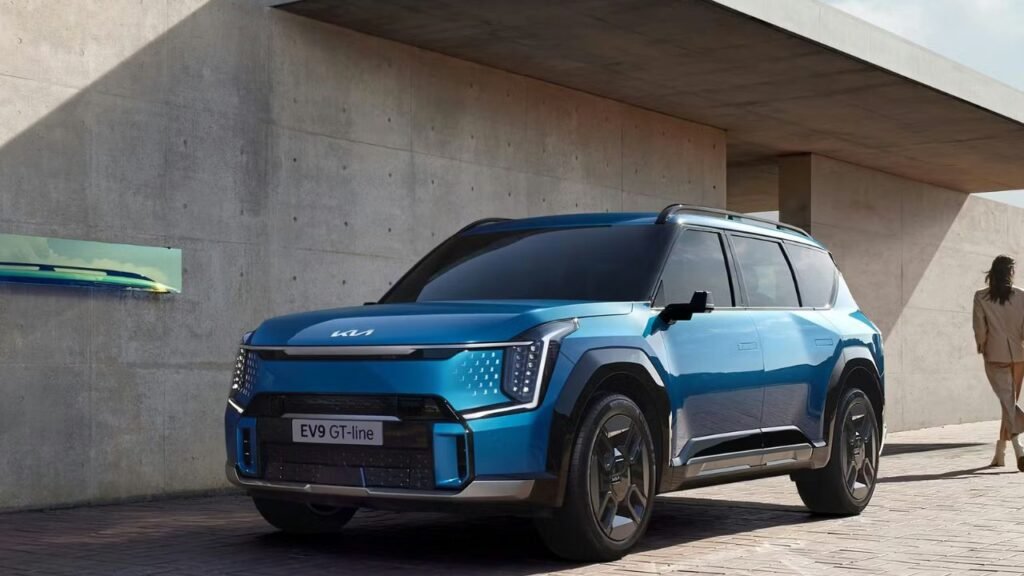
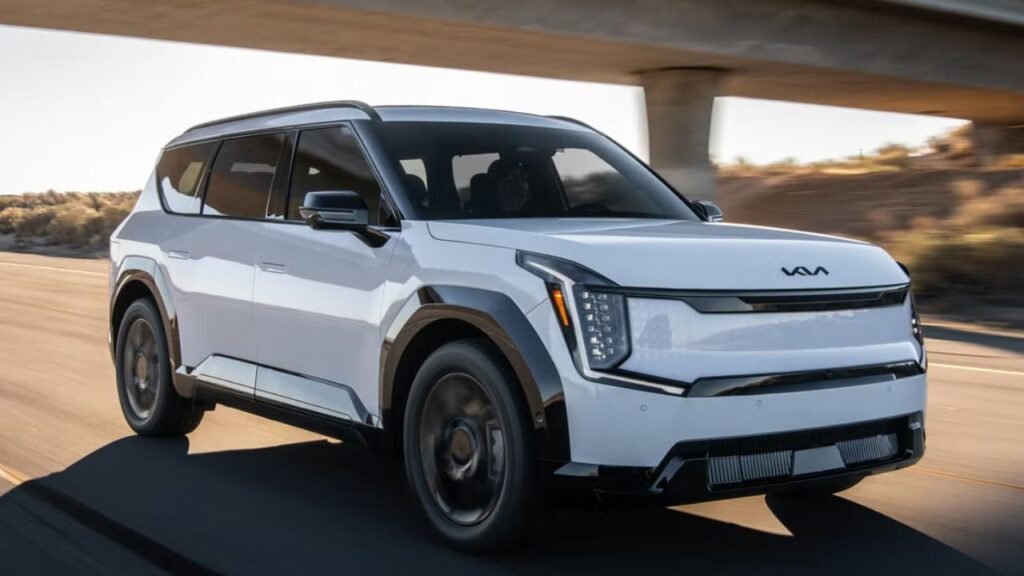
The Kia EV9 leans hard into traditional SUV bravado. It’s all sharp creases, upright glass, and aggressive, muscular geometry. Kia’s designers clearly wanted to evoke the ruggedness of their wildly popular gas-powered Telluride. With its “Tiger Face” digital grille and available blacked-out Nightfall Edition trim, the EV9 looks like a piece of high-tech tactical gear. It has a commanding, confident swagger that appeals directly to buyers who want an EV that doesn’t necessarily look like a science experiment.
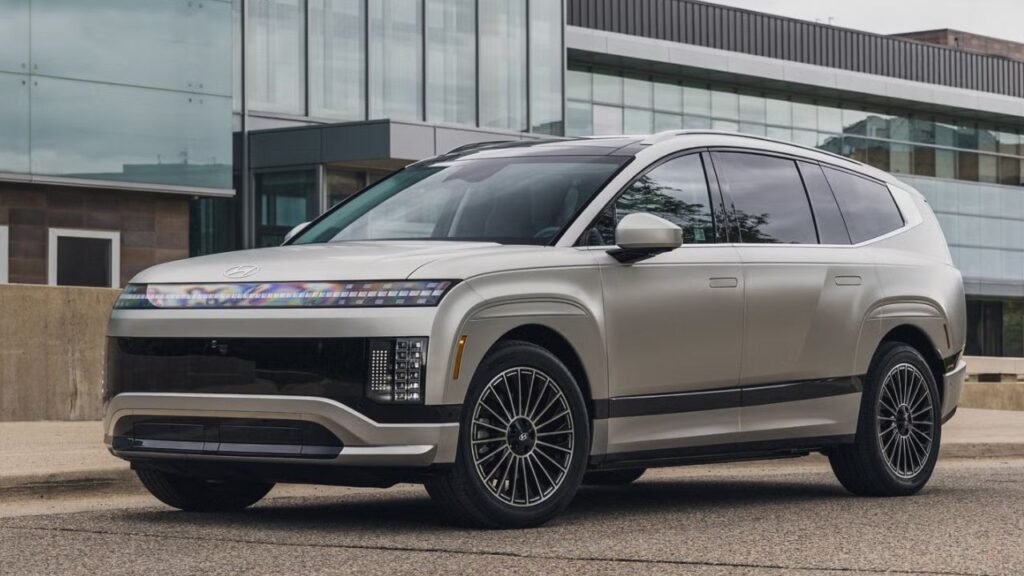
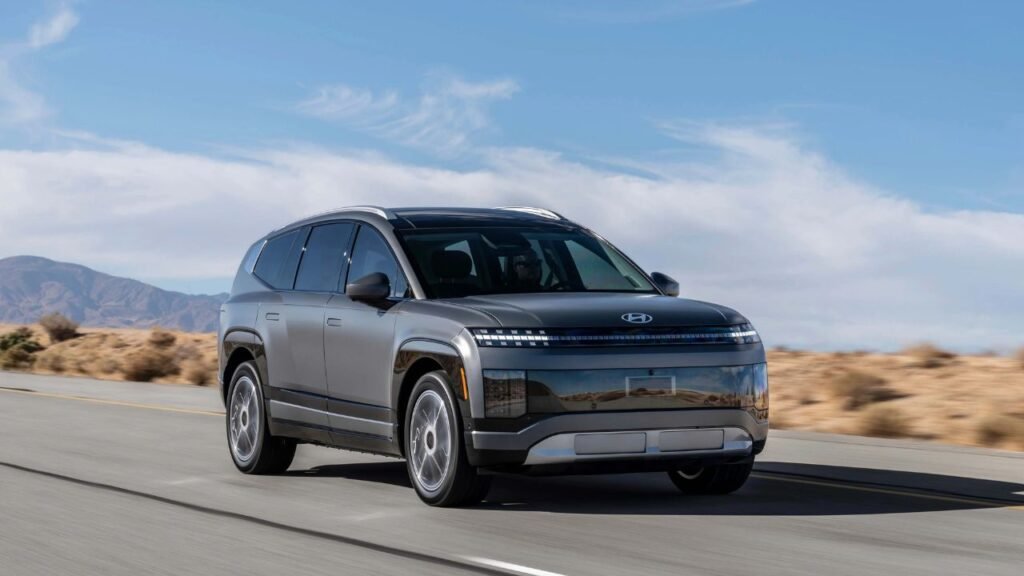
The Hyundai Ioniq 9, on the other hand, is an absolute masterclass in aerodynamic manipulation. Hyundai calls this design language “Aerosthetic,” and it shows. The vehicle flows with soft, sweeping curves, a raked roofline, and an incredibly low drag coefficient. It looks like a pebble that has been smoothed over centuries by a river. The Calligraphy Design trim, with its exclusive 21-inch turbine wheels and seamless pixel lighting, gives it a futuristic, lounge-like vibe. It reads less like a traditional SUV and more like a high-end, futuristic transport pod.
It’s purely a matter of personal taste. Do you want quiet, aerodynamic elegance, or do you want blocky, assertive brawn?
Interior Sanctuary: Screens, Storage, and the Third-Row Test
Here’s the truth about three-row SUVs: the battle is won or lost in the way back.
Let’s start with the Ioniq 9. Step inside, and you are immediately struck by how airy the cabin feels. Hyundai has utilized a massive amount of sustainable, eco-friendly materials—from recycled PET fabrics to eco-processed leather—that give the interior a bright, Scandinavian spa feel. But the real magic happens in the third row. Because of a brilliantly packaged flat floor and slightly different roof routing, the Ioniq 9 offers genuinely usable headroom and legroom for adults. I am six feet tall, and I can sit in the third row of the Ioniq 9 without my knees eating my chin.
“Hyundai’s interior packaging on the E-GMP platform is arguably the best in the industry right now. By pushing the wheels to the absolute corners of the chassis, they’ve unlocked interior volume that simply wasn’t possible with internal combustion constraints.” — Marcus Thorne, Senior Automotive Analyst, Global Auto Insights
The Kia EV9 fights back with utilitarian luxury. The interior feels slightly more conventional, which isn’t a bad thing. It boasts incredible small-item storage, a clever sliding center console, and fantastic second-row captain’s chairs. The EV9’s third row is still very good—miles better than anything in the mid-size gas segment—but it feels just a fraction tighter than the Hyundai.
Both vehicles feature massive, sweeping digital displays that integrate the gauge cluster and the infotainment system. While the software is largely similar, Hyundai has kept a few more physical buttons for crucial HVAC controls, which I vastly prefer when I’m driving 70 mph and just want to turn on the heated seats without diving into a touchscreen menu.
Performance and Towing: Highway Cruiser or Weekend Hauler?
If you want to know which vehicle suits your lifestyle, look at how they put their power to the pavement.
The Kia EV9 is the athlete of the two. In its dual-motor AWD setups, it churns out a stout 379 horsepower. But the absolute trump card is the available “Boost” mode. Press a button on the steering wheel, and torque temporarily spikes to an aggressive 516 lb-ft, rocketing this heavy family hauler from zero to 60 mph in roughly five seconds.
More importantly for outdoor enthusiasts, the EV9 towing capacity is a game-changer. When properly equipped with the Land AWD trim, self-leveling suspension, and trailering package, the EV9 can tow up to 5,000 pounds. It feels planted, confident, and unapologetically truck-like when pulling a heavy load.
The Hyundai Ioniq 9 takes a completely different path. While its top-tier Performance Calligraphy model actually beats the Kia on outright power (delivering a massive 422 horsepower), it never begs you to drive it aggressively. Instead, Hyundai’s engineers dialed in the torque-vectoring system and self-leveling dampers for pure, unadulterated serenity. It eats up highway miles with a supple, isolating ride quality that rivals European luxury SUVs costing twenty grand more. It’s quiet, composed, and effortless.
Range and Charging: The Real-World Reality Check
For the vast majority of EV buyers, range anxiety remains the ultimate deciding factor. This is where the aerodynamic witchcraft of the Hyundai pays massive dividends.
The Ioniq 9 range is currently the gold standard in this specific segment. Thanks to its teardrop-inspired shape and a slightly larger 110.3 kWh battery pack, the Ioniq 9 S RWD posts an incredibly impressive EPA-estimated 335 miles of range. Even if you upgrade to the heavier, more powerful dual-motor AWD versions, you are still looking at a highly practical 311 to 320 miles between charges.
The EV9, carrying a slightly smaller 99.8 kWh battery in its Long Range trims and fighting the wind with its boxy shape, maxes out at 305 miles for the RWD model. If you opt for the popular AWD variants, you’ll see that number drop to the 280-mile mark.
Does 30 to 50 miles of extra range matter? If you only drive to soccer practice and charge at home every night, absolutely not. But if you frequently take family road trips across state lines in the dead of winter—when EV batteries lose some of their efficiency—that extra buffer in the Ioniq 9 is the difference between making it to the next charger comfortably and sweating bullets in the slow lane.
Pricing and Value Proposition: The Bottom Line
Ultimately, you have to pay for all this electric goodness.
Kia has aggressively priced the EV9 to be the accessible entry point into the three-row electric market. It starts at an incredibly attractive $54,900 for the Light RWD model and tops out near $71,900 for the fully loaded GT-Line AWD. It represents a massive value proposition for buyers stepping up from a gas-powered Kia Telluride or Ford Explorer.
Hyundai positions the Ioniq 9 slightly upmarket. The base S RWD model kicks off at $58,955, and if you want the absolute pinnacle of their lineup—the loaded Calligraphy Design trim—you’ll be writing a check for $76,490.
“The pricing strategy is brilliant. Kia is capturing the volume market, bringing everyday families into the EV fold, while Hyundai is playing in the near-luxury space, directly targeting buyers who might otherwise look at a Rivian or an entry-level European EV.” — Sarah Jenkins, Director of Consumer Strategy, EV Market Research
The Verdict
We are finally past the era of having to compromise when buying an electric family vehicle. Both of these SUVs offer superb IIHS Top Safety Pick+ ratings, class-leading 10-year/100,000-mile battery warranties, and technology that actually makes your daily life easier.
So, how do you choose?
If your priority is maximum efficiency, a whisper-quiet, cloud-like ride, and a bit more breathing room for your teenagers in the third row, the 2026 Hyundai Ioniq 9 is the superior choice. It is a masterclass in electric refinement and aerodynamic engineering.
However, if you want a rugged, head-turning design, a lower starting price that is gentler on the wallet, and the ability to tow a 5,000-pound camper into the mountains on the weekends, the Kia EV9 remains the unbeatable value leader in the segment.
Don’t just read the spec sheets. The driving feel of these two corporate cousins is remarkably distinct. Book a test drive for both back-to-back, bring the kids, see how the car seats fit, and let the road decide. The electric family road trip is officially here.