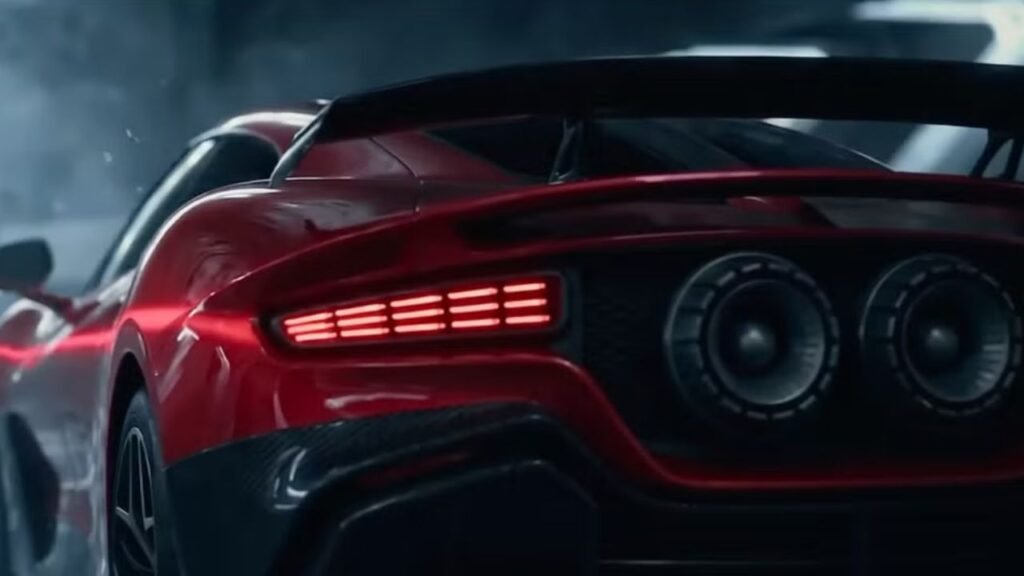
In the automotive industry, we are used to startups making wild claims, but strapping military-grade jet propulsion to a family-sized fastback is a new level of unhinged. That is exactly what Chinese robotics manufacturer Dreame has done with the Dreame Nebula Next 01 Jet Edition.
Unveiled on April 27, 2026, during the “Drive Next” event in San Francisco, this rocket-powered electric hypercar combines a nearly 1,900-horsepower electric drivetrain with two actual solid-fuel boosters to claim a zero-to-60 mph sprint of just 0.9 seconds. It’s a figure that doesn’t just push the envelope—it tears it into confetti.
Dreame is a brand you likely know for manufacturing high-end robot vacuum cleaners and hair dryers, making their jump into the hypercar space highly unexpected. But if their goal was to generate global publicity for their nascent automotive division, Star Motor, bolting rockets to a chassis is certainly one way to guarantee a captive audience. While the standard Nebula 01 was already a formidable EV, the “Jet Edition” represents a “hold my beer” moment in automotive engineering, aiming to solve the one problem every current hyper-EV faces: the physical limit of tire traction.
Reviving the Spirit of Solid-Fuel Booster Cars
To understand how bizarre—and potentially dangerous—this concept is, you have to look back to the 1960s. An aerospace engineer who worked on the Pershing ballistic missile program founded Turbonique, a deeply unsafe aftermarket company that sold rocket-powered superchargers and solid-fuel go-karts.
Their products frequently ran on isopropyl nitrate monopropellant—volatile rocket fuel that was as dangerous as it was fast. Those karts could hit 150 mph in the quarter-mile, often ending in a ball of fire if the throttle wasn’t managed with surgical precision.
Turbonique eventually folded for obvious safety and legal reasons, but the dream of thrust-powered vehicles never really died. For years, rumors have swirled about Tesla’s “SpaceX package” for the long-delayed Roadster, promising cold-air thrusters that could yield a 1.1-second 0-60 time. Dreame, however, has chosen to bypass “compressed air” in favor of something far more visceral.
While a traditional EV accelerates by gripping the pavement, introducing 100 kilonewtons of rocket thrust bypasses tire friction limitations entirely. However, engineering a consumer chassis that doesn’t twist under that immediate, localized force is a monumental structural challenge. You aren’t just building a car; you’re building a land-bound missile fuselage.
1,876 Horsepower Was Just the Baseline
The foundation for this madness is the standard Dreame Nebula 01, a Chinese EV concept that was already arguably too fast for public roads. Equipped with a quad-motor electric drivetrain, the base car pushes out a claimed 1,876 horsepower (approximately 1,399 kW) and targets a sub-two-second 0-62 mph time. For most people, that is plenty. It’s enough to rearrange your internal organs and make your passengers regret their life choices.
More Read

But for Dreame’s engineers, out-accelerating a Bugatti or a Rimac simply wasn’t enough. By mounting two custom-built jet propulsion nozzles at the rear—right where the license plate would sit—they unlocked 100 kilonewtons of extra thrust with a reaction time of under 150 milliseconds. When you engage the system, the Jet Edition supposedly crushes the 0-60 mph mark in 0.9 seconds.
To put that in perspective, that is nearly a full second faster than the current reigning production EV acceleration champion, the Rimac Nevera, which clocks in at 1.74 seconds. It even beats the world-record student race car from Switzerland, which achieved a 0.956-second run but lacked a roof, doors, or anything resembling safety equipment.
The Physics of a 0.9-Second Launch
What does a 0.9-second 0-60 launch actually feel like? In short: violent. A standard freefall under Earth’s gravity is 1.0 G. A launch this fast generates roughly 3.0 to 3.5 Gs of longitudinal force—comparable to what an astronaut experiences during a shuttle launch, but compressed into a tiny fraction of the time.
The primary hurdle for EVs like the Tesla Model S Plaid or Lucid Air Sapphire has always been the “Mu” (coefficient of friction) of the tires. Even with the stickiest Michelin Pilot Sport Cup 2Rs, there is only so much torque a rubber compound can transmit to the pavement before it simply turns into smoke. By utilizing rocket-powered electric hypercar technology, Dreame is using a “second engine” that doesn’t care about tire grip. The thrust pushes the car forward regardless of what the wheels are doing.
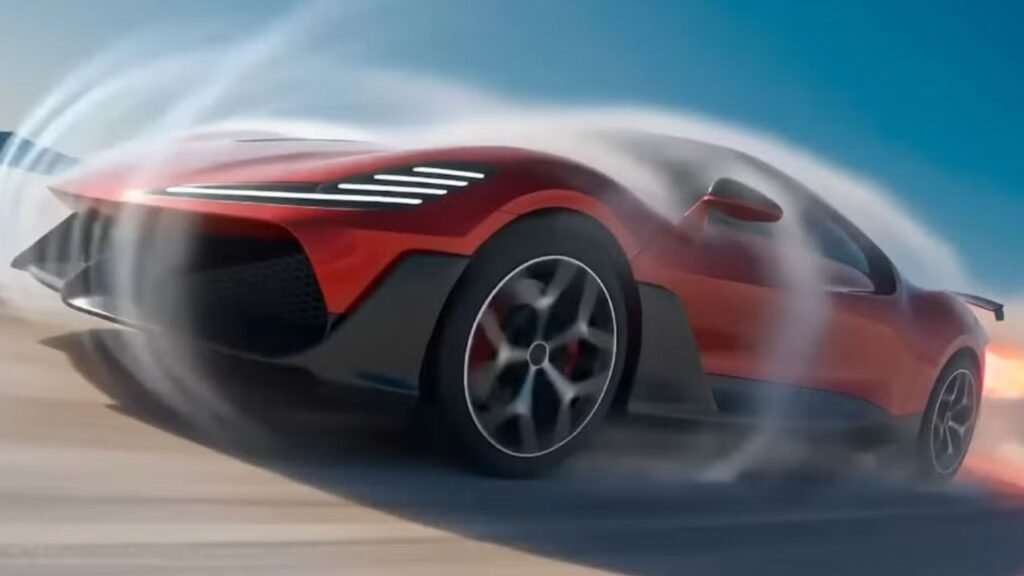
This introduces massive mechanical stresses. The chassis must be stiff enough to handle the 100kN of force pushing against the rear subframe without bending like a soda can. Dreame claims they’ve achieved this through a “Super Chassis” architecture that removes traditional crossbeams in favor of a structural CTP 4.0 (Cell-to-Pack) battery integration, which essentially turns the battery housing into the car’s spine.
Beyond the Boost: High-Tech Features That Might Survive
Look past the cartoonish rockets, and the Dreame Nebula Next 01 Jet Edition actually hides several legitimate technological advancements that will likely trickle down to production road cars under the Star Motor brand.
The DHX1 Full-Color LiDAR
Most notably, the hypercar features a next-generation high-definition LiDAR system, the DHX1, developed in partnership with silicon-valley giants. This isn’t your standard point-cloud sensor. It offers 4K-resolution image-level sensing with 4,320 channels and a 600-meter range.
“In all my life, I’ve never seen a product announcement as exciting as this,” said Sebastian Thrun, the father of modern autonomous vehicles, during the reveal. Where current LiDAR might see a “blob” that represents a pedestrian, the DHX1 can supposedly resolve fine details like traffic sign text or the specific movement of a small animal in total darkness.
Electromagnetic Active Suspension (EMAD)
The car also debuts a new electromagnetic active suspension system called EMAD. According to Dreame, this system offers 14 degrees of movement—eight more than the best conventional systems on the market today. This allows the car to lean into corners like a motorcycle or squat aggressively during a rocket launch to keep the nose from lifting.
Self-Evolving Energy Recovery
Leveraging their expertise in high-speed vacuum motors (which spin at upwards of 150,000 RPM), Dreame has developed an AI-driven energy recovery system. Instead of a fixed regenerative braking setting, the car builds a personalized model of the driver’s habits. Dreame claims this can improve high-speed range by up to 12% by perfectly matching energy flow to the driver’s unique “cadence”.
The Reality of Rocket-Propelled Commuting
Can you actually buy a car with rockets on it? Don’t bet on it for your morning school run. There are massive regulatory hurdles to clearing a road car that would instantly melt the bumper of a Toyota Corolla at a traffic light.
Furthermore, solid-fuel rockets are “all or nothing.” Unlike an electric motor, you cannot gently modulate the throttle of a solid-fuel booster. Once you light the candle, you get a singular, violent burst of thrust until the fuel is spent. If you try to “abort” or lift off the accelerator early, you risk a catastrophic pressure buildup or mechanical failure. As a daily driver, it’s completely impractical. As a salt-flat stunt car or a limited-run track toy, it’s a technical masterpiece.
There is also the question of “emissions-free” driving. While the quad-motor setup is as green as it gets, solid rocket fuel is… not. The exhaust from such boosters often contains perchlorates and other chemicals that are decidedly not Euro-7 compliant.
The Bottom Line: A 1,876-HP Marketing Masterstroke
The Dreame Nebula Next 01 Jet Edition is not a car you will see at your local dealership anytime soon. It is a “flex”—a rolling billboard designed to prove that a company known for cleaning floors has the engineering chops to compete in the cutthroat electric vehicle market.
Even if the solid rockets are inevitably stripped away by regulators, the blistering electric powertrain, the 24-degree rear-wheel steering, and the cutting-edge DHX1 sensor suite prove that Dreame’s automotive ambitions are very real. They have already partnered with BNP Paribas to build a state-of-the-art factory outside Berlin, aimed at producing more “grounded” luxury SUVs and supercars starting in late 2026.
They’ve lit the candle and shown the world what is possible when you stop following the rules. Now, we wait to see if the production-ready Star Motor vehicles can actually launch with the same intensity. One thing is certain: the old-school “grease monkeys” of the automotive world officially have a new, very high-speed competitor to worry about.